

Philip Cubeta, Founder of Philanthropy Offerings.
Phil Cubeta has spent decades advising wealthy families on giving, and has trained more than 2,000 philanthropic advisers and gift planners.
We caught up with him to understand what those experiences taught him about the relationship between wealth, philanthropy and a meaningful legacy.
Philanthropy isn’t something pursued by all wealthy families, so it’s surprising when he says that he feels almost all wealth creators have an impulse to make a positive difference.
“Some lack the language for it. Some are even embarrassed to admit it, but they feel called to serve, each in their own way. It is more about listening to them than convincing them. In the silence between assured statements come felt truths.”
Philanthropy and the family office
When asked about how philanthropy should sit within a family office, Cubeta’s answer hints at the inherent complexities.
“Self, family, and society. How do you balance those? Now, at death, beyond death? Do you want to be a dynastic family whose wealth, influence, and power compound over generations? Or do you want to play a good game of Monopoly and then put the pieces back in the box?
Advisors advise on wealth. They seldom counsel giving it all away, and it can be hard to do that responsibly, but some families come to that conclusion. Carnegie did; as did Bill Gates and Warren Buffett. Whatever you decide, though, the heirs should not be left guessing as they make their own life plans.”
And when it comes to common mistakes he sees families make with philanthropy, one of the biggest he sees: relying on experts for what matters most!
“You can delegate so much in life, at work, at home, and in giving. But what do we lose when it becomes another routine to be offloaded? Experts can handle the tools, file the forms, do the admin, but the heart and soul of it must be the donor’s.”
He’s adamant that philanthropy should always be approached hands-on.
“You set direction, you determine what success looks like, you make your own way, as you have in business. Don’t treat giving as decorative or as a dismal task; follow where joy leads.”
Next generation and family legacy
Philanthropy is often presented as an ideal way to engage the next generation, but does it necessarily bring families together?
“Giving like anything else, even picking a restaurant, can bring us together or exacerbate conflicts. If the money is already slated for giving, perhaps there is less to fight over, but people can fight over who gets grandmother’s hairbrush.”
When it comes to giving, Cubeta says that teaching kids independence is good, but being interdependent is also good, particularly for those who will inherit shared structures.
“As heirs, they will find that much of their lives are intertwined. Not just giving, but also business interests, trusts, vacation homes, and investments.”
For parents who may end up at odds with strong-willed heirs, Cubeta says giving can be a useful tool, but has limits.
“Giving won’t fix it, but it could provide an occasion, pretext, or rationale to address it. There are many consultants who work on “family dynamics.” It may be worthwhile to check with peers to see who they have used. You are not alone with these issues!”
Scale and controversy
Philanthropy has become an enormous field, supported by foundations, consultants, advisers and intermediaries.
While the professionalisation might have made philanthropy more efficient, Cubeta still feels this is a field best led by talented amateurs.
“Philanthropy is one of the things we do for love. Somehow it does not scale in quite the same way as a business. The most important skill I teach advisors is listening, not for information, but for the awakening in the donor of the donor’s own sense of mission or purpose.”
Cubeta has also suggests that the growing political polarisation of philanthropy is a factor that wealthy families must consider.
“Family members or branches of the family may be at odds. Individuals may want to take stands that others do not. Influencing elections and lobbying are adjacent to philanthropy but have their own rules and regulations. Taking strong stands may incur reputational and other risks. My best thought is to educate yourself and make principled decisions under conditions that are uncertain and ever-shifting.“
Failing spectacularly
Having worked with wealthy families throughout his career, Cubeta believes the greatest inhibitor for successful people is the illusion that giving must be done well, or smart, or right.
“Give, see how it goes, give again. Double down when it goes well. Learn from peers. Recover, if you can, the sheer delight of a child at play.”
He believes the best advice is to learn from our own best efforts and see each disappointment as a learning experience, as it is in business.
“You know the story: A young grandchild asked the wise old grandparent. ‘How did you get so wise?’ The grandparent replied, ‘By experience.’ The grandchild asked, ‘How did you get experience?’ The grandparent said, ‘By failing spectacularly.’”
-
Advertisement

CION Investments is a manager of alternative investment solutions including infrastructure and private credit interval funds.
Interval funds are gaining traction as a way for family offices to access private markets. The latest Mr. Family Office thought leadership piece explains how these 1940 Act vehicles work, why launches have accelerated, and where they fit alongside direct private-market commitments. It also covers their key advantages and trade-offs, along with the due diligence questions allocators should ask before investing. Discover what sets CION apart at cioninvestments.com.
𝕏 highlights
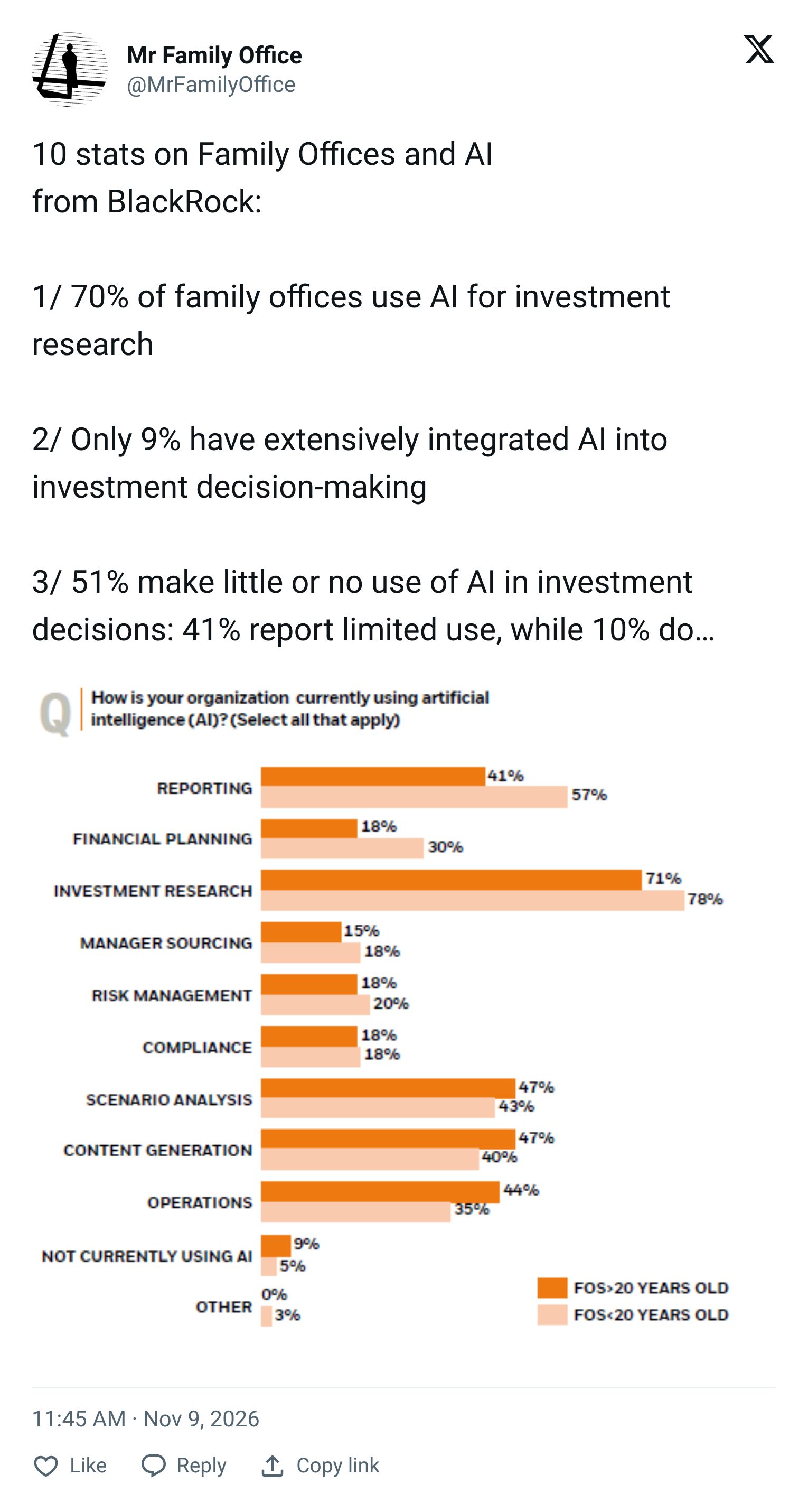
10 stats on family offices and AI.
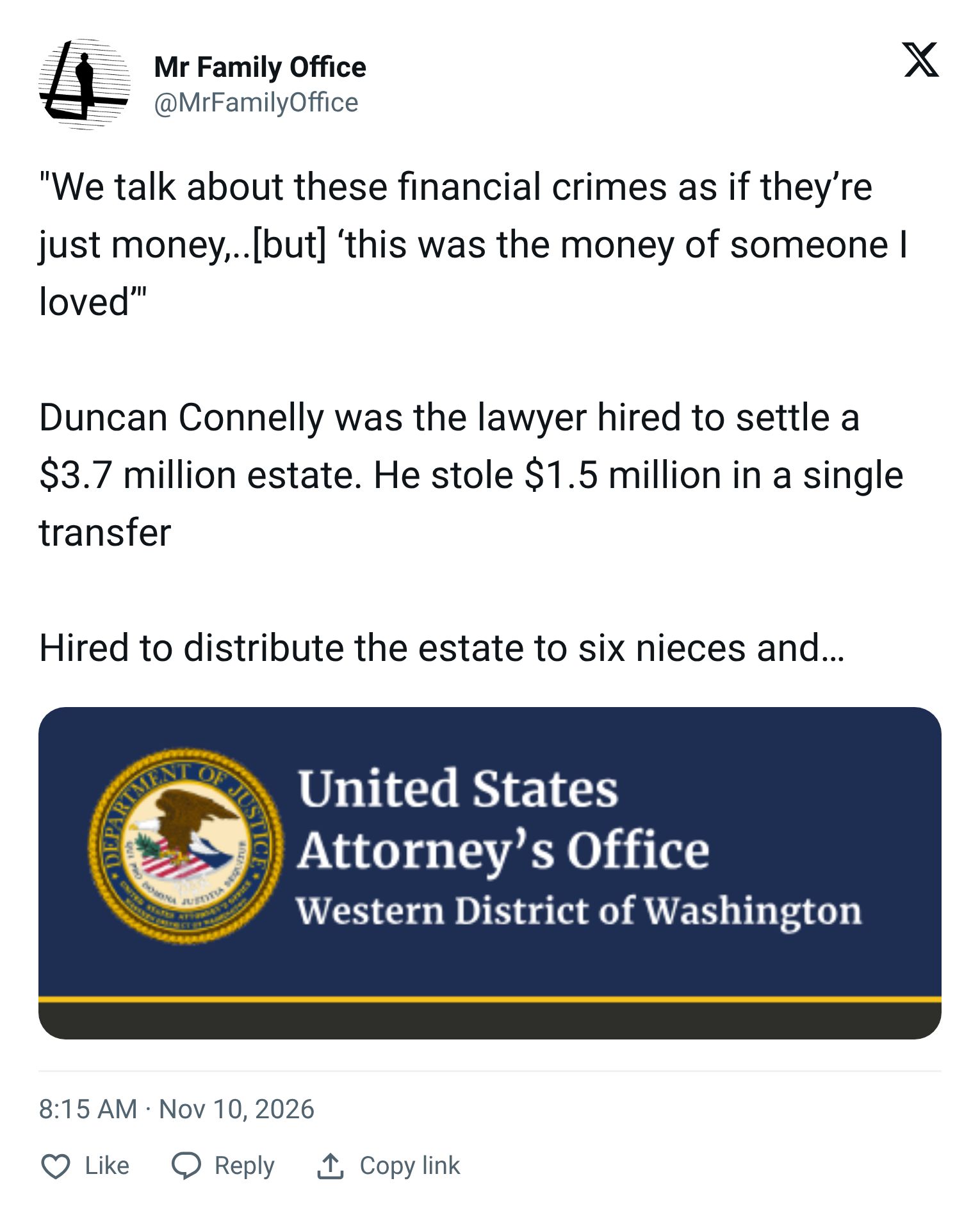
How a trust lawyer stole from nieces and nephews.
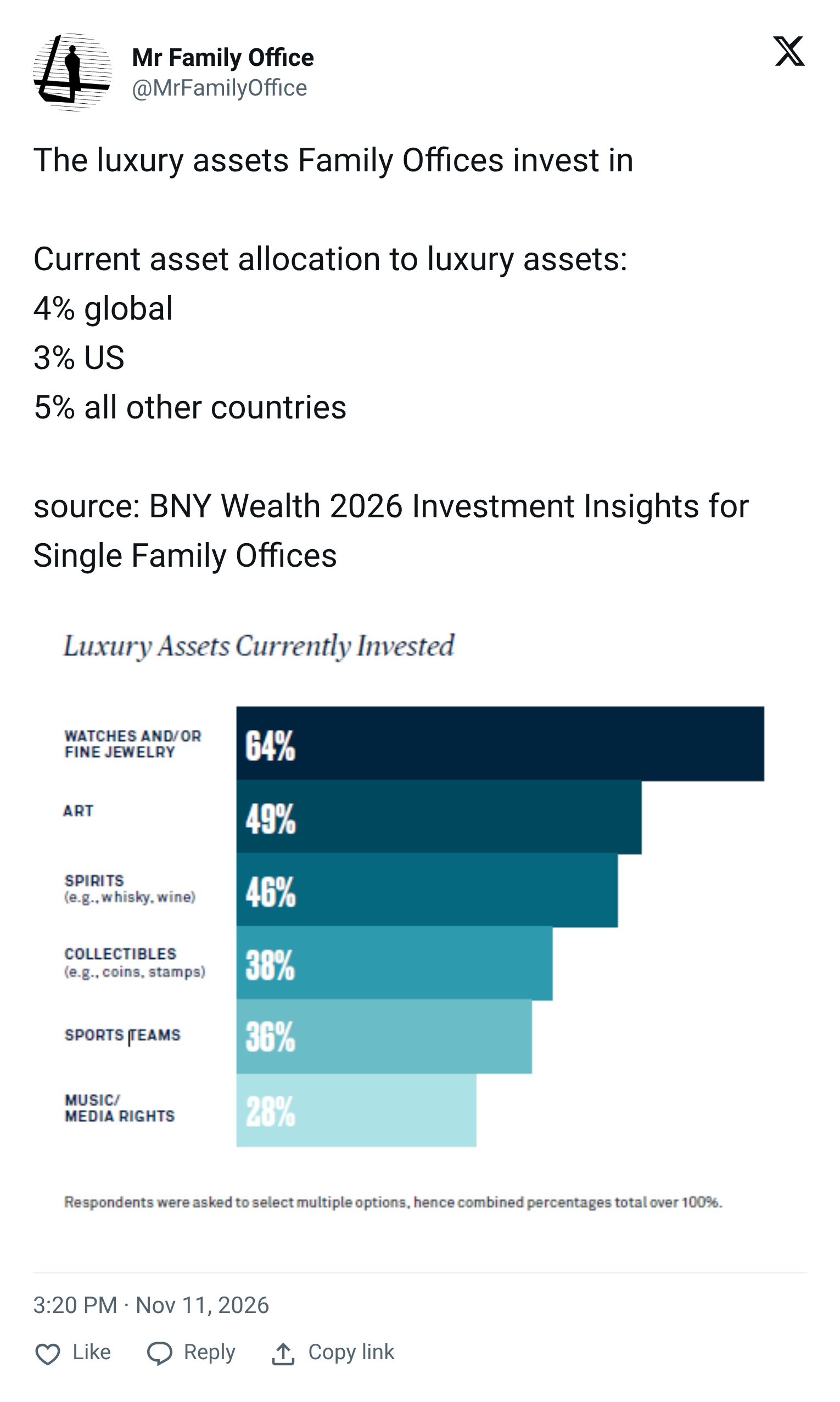
Luxury assets held by familly offices.
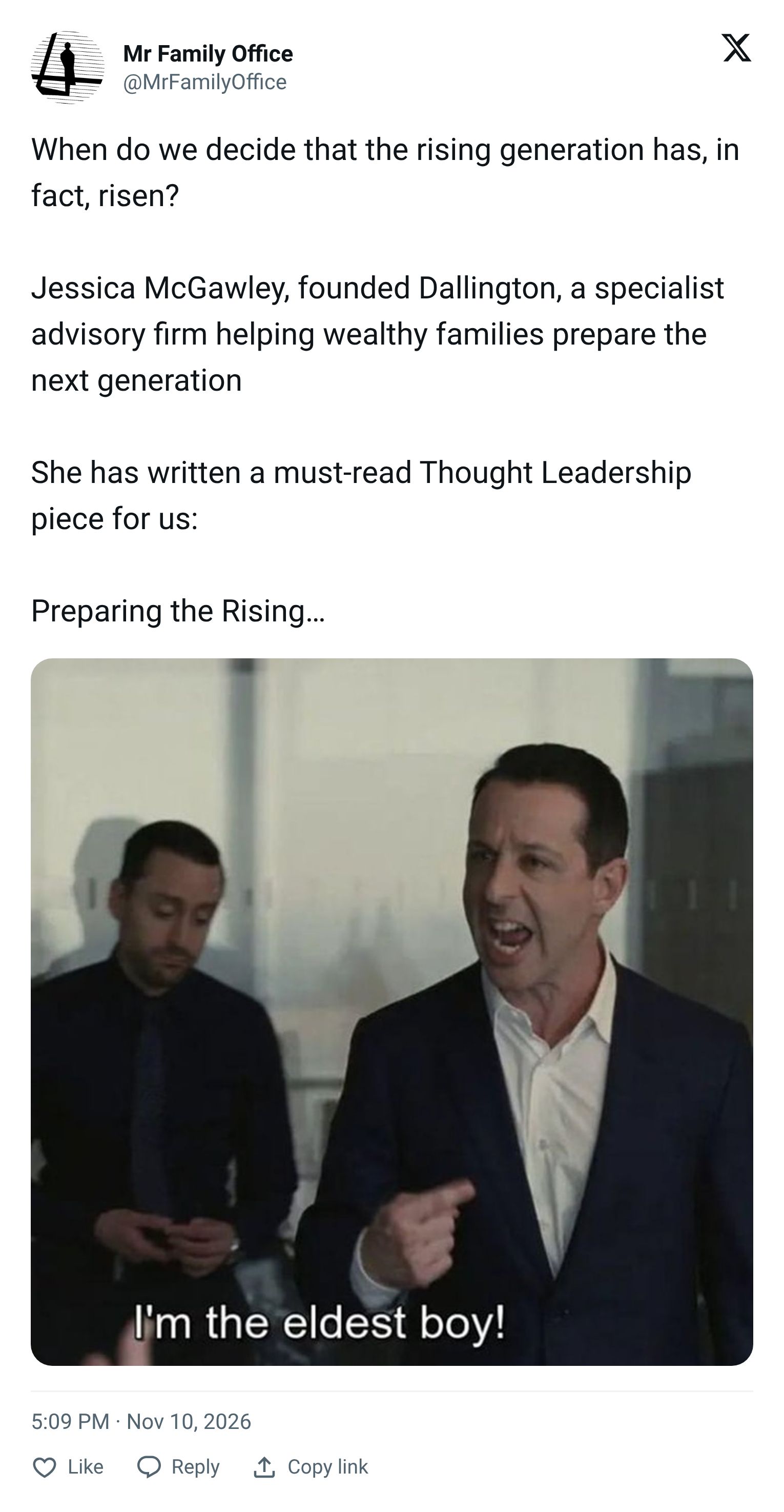
Who decides when the rising generation has risen?
Where to work
Three family office industry jobs posted this week…
What to read
The Family Philanthropy Navigator by Peter Vogel, Etienne Eichenberger and Malgorzata Kurak is a practical guide for wealthy families looking to make their philanthropy more meaningful and effective. It encourages families to think carefully about why they give, what they want to achieve and how to structure their giving. Lots of real-world examples and step-by-step exercises.

What to listen to
In this episode of Declarations, Todd S. Rich and Brian Adams, of Mack International, discuss how family offices are evolving and what that means for the professionals working within them.
They explore the shift from creating wealth to preserving and managing it, the advantages of patient capital, and changing approaches to investment strategy. The conversation also covers compensation, and career opportunities for versatile professionals.

What to watch
In the recent BNY Wealth Single Family Office report, 36% of family offices reported investments in sports teams. In this video, Nicole Pullen Ross, Head of Sports and Entertainment Solutions at Goldman Sachs Private Wealth Management, explores the growing appeal of sports as an investment, fueled by booming media rights deals and soaring team valuations.
ICYMI
Also popular this week…
Is NYC’s Pied-à-Terre Tax Deterring UHNWs? Why many wealthy buyers are still keen to buy amid ‘chaotic’ second-home charge.
The Centralized Household Operating System. Software that helps wealthy families manage their properties, assets, and all the details of life at home.
Preparing the Rising Generation: Exposure Is Key. Why treating the next gen as if they're on constant probation is ill-advised.

And finally…
If you have a family office philanthropic-related story you’d like to share, or someone that you think has an interesting perspective on the theme, hit REPLY to let us know!
Right, that’s all for this week.
X


